
Richmond Hill is home to a beautiful array of vintage properties, from mid-century bungalows near Crosby to century-old estates closer to the heritage district. However, owning an older home in York Region comes with a unique set of structural challenges, primarily due to the local soil composition and the sheer age of original waterproofing systems.
As these foundations settle over decades, the combination of heavy Southern Ontario snowmelt and dense clay soil can lead to significant structural distress. Understanding which repair methods are tailored for older concrete, cinder block, or stone foundations is essential for homeowners looking to protect their investment.
Addressing these issues correctly now ensures that your piece of Richmond Hill history remains standing strong for the next generation.
High-Pressure Polyurethane Injection for Poured Concrete
Many homes built between the 1950s and 1970s in Richmond Hill feature poured concrete foundations that are prone to vertical or diagonal shrinkage cracks. Polyurethane injection is a non-invasive, highly effective “inside-out” repair method that handles the shifting moisture levels typical of the GTA.
- Flexibility: Unlike rigid epoxy, polyurethane remains flexible after curing, allowing it to move with the natural expansion and contraction of the soil.
- Active Leak Stopping: This material reacts with water to expand up to 20 times its volume, effectively choking out active leaks during the spring thaw.
- Minimal Disruption: The repair is performed from the interior, meaning your mature landscaping and interlocking brick driveways remain untouched.
This method is often the first line of defence for Richmond Hill residents who notice seepage after a heavy rainstorm. It provides a permanent, cost-effective seal that prevents water from reaching the reinforcing rebar inside your walls.
Exterior Waterproofing and Weeping Tile Replacement
For many older properties, the original clay weeping tiles have long since collapsed or become clogged with silt and tree roots. Excavating the exterior perimeter to install a modern drainage system is often the only way to truly “dry in” a basement that suffers from chronic dampness.
- Multilayer Protection: Professionals apply a rubberized membrane followed by a dimpled drainage board to keep hydrostatic pressure away from the masonry.
- Modern Drainage: Replacing old tiles with perforated PVC piping ensures that groundwater is diverted to the sump pit or storm sewer efficiently.
- Structural Inspection: Digging out the foundation allows for a full visual inspection of the footings, which is vital for homes over 60 years old.
While this is a more significant undertaking, it is the gold standard for long-term protection against the high water tables found in parts of York Region. It essentially wraps your home in a waterproof envelope, significantly increasing the usable square footage of your basement.
Carbon Fibre Reinforcement for Bowing Walls
In areas of Richmond Hill with high clay content, the soil can exert massive lateral pressure against foundation walls, causing them to bow inward. Carbon fibre straps offer a space-age solution that provides incredible tensile strength without the need for bulky steel beams.
- Low Profile: The straps are thinner than a penny and can be easily painted over or hidden behind a finished wall.
- Permanent Stabilization: Once bonded to the wall with high-strength epoxy, the carbon fibre prevents any further inward movement.
- No Excavation Required: This structural fix is performed entirely from the inside, saving the homeowner thousands in landscaping costs.
This technology is particularly useful for the cinder block foundations common in mid-century Richmond Hill builds. It restores structural integrity to the home without changing the footprint or aesthetics of the interior space.
Helical Piering for Subsidence and Settling
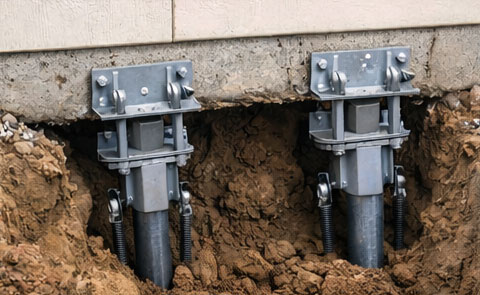
If you notice doors sticking, cracks in the drywall upstairs, or a tilting chimney, your older home may be experiencing foundation settlement. Helical piers act like giant screws that are driven deep into the earth to bypass unstable topsoil and reach load-bearing strata.
- Weight Redistribution: The weight of the house is transferred from the failing foundation onto the steel piers.
- Foundation Levelling: In many cases, hydraulic jacks can be used to slowly lift the house back toward its original level position.
- Year-Round Installation: These can be installed even in the winter, which is a major advantage for Ontario homeowners facing sudden structural shifts.
Settlement issues are common in older neighbourhoods where the soil has been disturbed or compacted unevenly over time. Piering is a sophisticated engineering solution that addresses the root cause of the movement rather than just patching the symptoms.
Parging and Masonry Restoration
The visible portion of your foundation above the grade, known as the parging, often takes a beating from salt, ice, and weed-whackers. For older homes, maintaining this protective layer is the first step in preventing spalling and water ingress.
- Sacrificial Layer: Parging is designed to take the brunt of the weather so your structural blocks or concrete don’t have to.
- Aesthetic Appeal: New parging gives an older home a refreshed, well-maintained look that boosts curb appeal.
- Crumbly Masonry Fix: Professionals use specialized mortars that are compatible with the softer lime-based materials found in Richmond Hill’s oldest heritage homes.
Regularly inspecting and renewing your parging is one of the most affordable maintenance tasks a homeowner can perform. It acts as a primary barrier against the elements and prevents small surface issues from turning into deep structural rot.
Ensure Your Richmond Hill Heritage Stands the Test of Time
Don’t wait for a damp basement or a sticking door to become a structural emergency. By choosing the right repair method for your home’s specific age and construction type, you can avoid the “money pit” scenario and enjoy a dry, stable property for decades to come.
Whether it’s a simple injection or a full-scale waterproofing project, the peace of mind that comes with a solid foundation is the best upgrade you can give your home.