
In Canada, our homes are constantly under siege by the elements. Between the heavy snow accumulation of winter and the torrential rainstorms of spring, the soil surrounding your foundation often holds thousands of litres of water. When this moisture stays trapped against your basement walls, it creates immense “hydrostatic pressure” that eventually forces its way through the concrete, leading to dampness, mould, and structural decay.
Exterior waterproofing is the most comprehensive way to stop this cycle because it addresses the problem at the source—outside your home. Rather than managing water once it has already entered your basement, this method creates a physical, watertight envelope around your foundation.
For homeowners in regions with heavy clay soil or high water tables, like many parts of Ontario, this isn’t just a home improvement project; it’s a vital long-term investment in the skeletal integrity of your property.
The Excavation: Reaching the Footing
The process begins with excavating the soil around the perimeter of your home down to the “footing,” which is the very base of your foundation. This is necessary because surface-level patches cannot stop groundwater from rising up through the bottom of the walls.
- Trenching: A trench is dug roughly 2 to 3 feet wide, providing enough space for technicians to work directly on the exterior masonry.
- Cleaning the Substrate: Once the wall is exposed, it is power-washed to remove dirt, old tar, and loose parging so the new materials can bond perfectly.
- Visual Assessment: This is the only stage where a professional can see the true condition of your foundation’s exterior, identifying hidden cracks that interior inspections miss.
By exposing the entire wall, you ensure that every square inch of your home’s “underground” surface is accounted for. This deep-dive approach is what makes exterior waterproofing significantly more reliable than interior-only patches.
Sealing the Concrete with Rubberized Membranes
Once the walls are clean and dry, a high-grade rubberized asphalt membrane is applied. Unlike the thin “damp-proofing” spray used in many new-build subdivisions, this professional membrane remains flexible and won’t crack during Ontario’s extreme temperature swings.
- Pliable Protection: This layer expands and contracts with the house, ensuring that small settlement cracks don’t break the waterproof seal.
- Seamless Barrier: The membrane is typically applied as a liquid or a torch-on sheet, creating a continuous “skin” that water cannot penetrate.
- Reinforcement: Extra attention is paid to the “cove” area—the critical joint where the wall meets the footing—where most leaks originate.
Think of this membrane as a high-tech raincoat for your house. It ensures that even if the ground is completely saturated, the concrete remains bone-dry and protected from the corrosive effects of groundwater minerals.
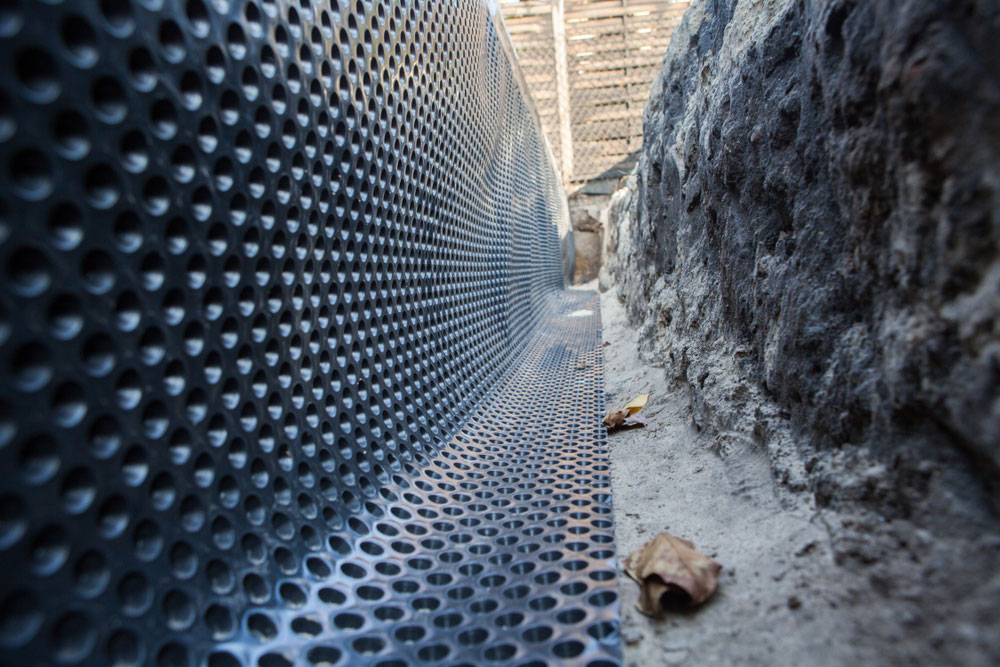
Installing the Dimpled Air-Gap Drainage Board
To protect the rubber membrane and provide an escape route for water, a heavy-duty dimpled plastic board is installed over the entire foundation wall. This board acts as a “drainage plane,” using gravity to pull water downward before it can even touch the wall.
- Pressure Relief: The dimples create an air gap that neutralizes hydrostatic pressure, preventing water from being “pushed” into the concrete.
- Mechanical Shield: This tough plastic layer protects the soft rubber membrane from being punctured by rocks or debris when the trench is eventually backfilled.
- Flow Direction: Water hits the board and immediately falls to the weeping tile system at the bottom, rather than sitting stagnant against your home.
This secondary layer is essential for managing the sheer volume of water produced during a rapid spring melt. It works in tandem with the membrane to ensure that “wet soil” never translates to a “wet basement.”
Replacing the Weeping Tile System
At the base of your foundation lies the “weeping tile”—a perforated pipe designed to collect groundwater and carry it away. In older Canadian homes, these are often made of clay or concrete and are frequently clogged with silt, roots, or collapsed sections.
- Modern PVC: Old tiles are replaced with high-quality perforated PVC piping wrapped in a “filter sock” to prevent fine soil from entering the system.
- Gravel Bedding: The pipe is buried in a thick layer of clear ¾-inch crushed stone, which acts as a natural filter and allows water to flow freely.
- Connection to Discharge: The system is tied into a sump pump or the municipal storm sewer to ensure the water is moved far away from your property.
A functioning weeping tile is the “engine” of your waterproofing system. Without it, the water has nowhere to go, which is why replacing an aged system is the most critical step in any exterior project.
Proper Backfilling and Grading
The final stage involves filling the trench back up and ensuring the ground is sloped away from the house. Many basement leaks are caused by “negative grading,” where the soil has settled over time and now directs rainwater toward the foundation.
- Layered Compaction: The soil is replaced in stages to prevent future “sinkholes” or dramatic settling around your flower beds.
- Positive Slope: The final grade should drop at least 1 inch for every foot of distance away from the foundation.
- Downspout Extension: While the soil is open, it’s the perfect time to run eavestrough downspouts underground to discharge water 10 feet or more away from the house.
Proper grading ensures that your new waterproofing system doesn’t have to work harder than necessary. By directing the bulk of surface water away from the house, you drastically reduce the load on your weeping tiles and sump pump.
Future-Proof Your Home Against the Elements
Exterior waterproofing is more than just a repair; it is a permanent structural upgrade. By stopping water before it ever enters your foundation walls, you eliminate the risk of mould, rot, and the “musty basement” smell that plagues so many Canadian properties.
While the process is an investment, the peace of mind it provides during a heavy spring thaw is priceless. Your home is likely your biggest asset—ensure it stays on a dry, solid foundation for generations to come.